SidraMiconi.com · Gemini 4 Neon · November 19, 2026
POV of a sunbeam when it's asked to make a rainbow
A 55-second film that is pure code by Gemini 4 Neon. Seven photons leave the Sun on rainbow duty, and a raindrop sends each one out at its own measured angle.
- Pure code by Gemini 4 Neon
- Real angles
- Play it live
What is real in it
Every angle in it is real: water's measured refractive index sends violet out of the drop at 40.6° and red at 42.4°, and sunlight takes 8 min 13 s to reach Earth on November 19, 2026.
Data: Daimon & Masumura, Applied Optics (2007); NASA JPL Horizons.
How 8 min 13 s is worked out
NASA JPL Horizons puts Earth 0.988424 astronomical units from the Sun on November 19, 2026. That is 0.988424 × 149,597,870.7 km, or about 147.9 million km. Light covers 299,792.458 km every second, so the trip takes 493.2 seconds, which is 8 minutes 13 seconds.
A raindrop bends the light in, bounces it once off the back of the drop, and bends it out again. Violet leaves at 40.6° from the point opposite the Sun and red at 42.4°, so the colours fan out into a band.
Real: the two angles and the travel time. Drawn by the code: everything you see.
Play it live
This is the page the film was recorded from, written as pure code by Gemini 4 Neon, with two small hand fixes: the credit line and the phone layout of its controls. Press play, drag the timeline to any moment, or press the space bar to pause.
Pure code by Gemini 4 Neon, with two small hand fixes: the credit line and the phone layout of its controls. Open it full screen.
Next to it
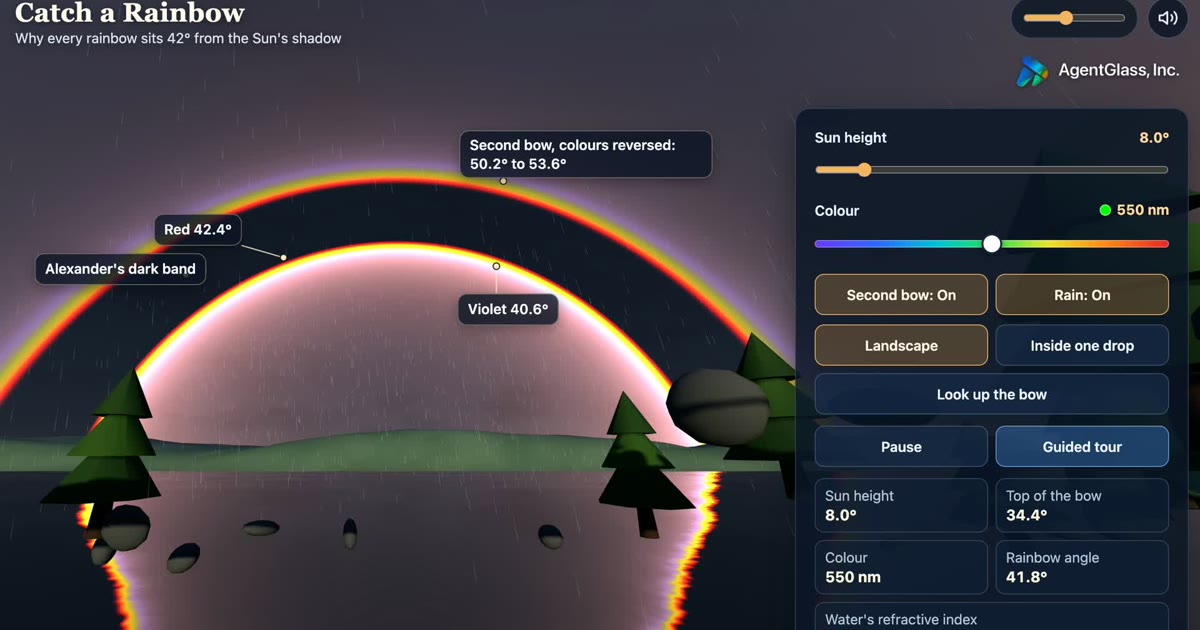
Catch a Rainbow
Drag the Sun and watch a real double rainbow sink below the horizon. It uses the same measured angles the sunbeam follows, and it is also built by Gemini 4 Neon.